Hiển thị các bài đăng có nhãn Vietnamese. Hiển thị tất cả bài đăng

Thứ Ba, 30 tháng 9, 2014

Banh Trang Tron - Rice Paper Salad


Banh trang tron 'rice paper mix' is a street food that has won the hearts of children and teenager all over Vietnam.  I was first introduced to this popular street snack several years ago while I was in Saigon.  My cousin picked up a bag on his way home from class.  He walked in with a clear plastic bag dangling from his fingers with two skewers (used as chopstick) poking out from the bag.  I opened up the bag to examine what was inside; strips up rice paper, julienned green mango, shredded beef jerky, quail egg, roasted peanuts, and chopped Vietnamese coriander (rau ram).  It was such an unusual concoction but had all of my favorite components.  I'm always excited to try new food so I had no problem digging in.  While I very much enjoy the explosion of flavors, my mom thought it was 'nonsense' food.

Upon my first tasting of banh trang tron, I thought it tasted similar to padd Thai.  After a few more bites the flavor became more coherent; it was tangy and spicy similar to other Vietnamese goi but more salty and dry.  I can see why adults would be against this type of snack, it's not very nutritious.  But it's FUN food, something I like to make every now and then.  I hope you enjoy my interpretation of this popular street food!

Ingredients:
8-10 sheets of rice paper cut into 3 inch strips
1 cup of julienned green mango (adding more green mango will add more moisture to this salad)
1 cup of chopped rau ram
1/4 cup of dried proteins (shredded beef jerky, shredded squid, dehydrated field shrimp, or none)
quail egg (or 1 hard boil egg cut into 8 pieces)
2 tablespoon of cooking oil
3 tablespoon of minced green onion
shrimp salt 'muoi tom' ( or sea salt)
sugar
1 lime
maggi seasoning
chili oil
fried shallot
crushed peanuts
large bowl
plastic gloves

1.  Sauteed the green onions in the oil until fragrance.  If you are using tep kho (dehydrated field shrimp) add it to the oil and sauteed until fragrance.
2.  Add the rice paper strips to a large bowl and the add the hot oil with green onions and tep kho.  Use your gloves to mix as much of rice paper and oil together to help soften the rice paper.
3.  Season the rice paper with 1 lime, some shrimp salt (sea salt is a lot saltier so use it sparingly), a sprinkle of sugar, juice of 1 lime, hot chili oil, and a couple dash of maggi seasoning.  Mix well or it will get clumpy.  Make sure every portion of the rice paper is season thoroughly.
4.  Once you are satisfied with the seasoning add the green mango, shredded protein, quail egg, chopped rau rau, crush peanuts, and fried shallot.  Toss and mix so that all the components are evenly distributed.
5.  Enjoy!

Thứ Bảy, 10 tháng 5, 2014

Che Chuoi - Banana Coconut Pudding

Not only am I not a huge fan of dessert, I don't even like eating bananas.  Oddly there is something so comforting and tasty about a bowl of che chuoi, and it's making me break all my rules.  My sister-in-law taught me how to make this che over the phone, so it's quite simple to make.

This che does require a specific type of banana, the short Asian bananas (looks like baby bananas).  I'm sure you can use regular bananas but it won't taste as good.  The short bananas has more starch, is more firm, and is less sweet than regular bananas.  It will hold up better during the cooking process and there will be more of a bite to it (regular bananas will get too mushy).  Make sure the bananas are ripe before making this che otherwise these short bananas will have a bitter taste. Enjoy!

Ingredients:

1 hand of RIPED banana (the short Asian kind if possible)
1 can of coconut
2 cups of cubed cassava roots (I use the frozen kind)
1/4 cup of tapioca pearls
sugar
salt
water

1.  Cut bananas down about 1 inch in length.  Marinate bananas with about 5 tablespoon of sugar, let it marinate overnight so you can make it the next day.
2.  Boil the cassava roots until it's about 60% done, you will finish cooking it in the coconut milk.  I like my cassava roots pretty firm otherwise it will fall apart.  Cube the cassava roots to about 1/2 inch.
3.  Wash your tapioca pearls.
4.  Pour the entire can of coconut milk in a large pot on medium heat.  Fill up that coconut milk can with water and stir it in with the coconut milk.
5.  Add the cubed cassava roots and the tapioca pearl.  Add about 4-5 tablespoon of sugar and a pinch of salt.  More or less sugar depending on how sweet you like, don't forget the bananas were marinated with additional sugar.
6.  Let the cassava roots cook in the coconut milk until the tapioca pearl has expand.
7.  Add the marinated bananas.  Let the bananas cook until it's tender.  I like my bananas firm so it's about 10 minutes.
8.  Transfer to bowl and enjoy with roasted peanuts.

Thứ Tư, 7 tháng 5, 2014

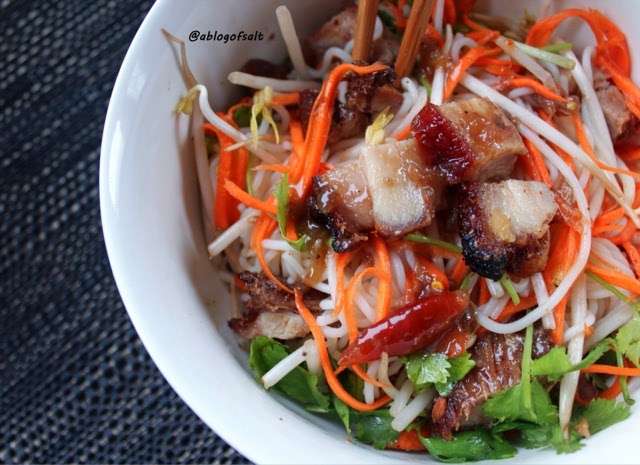
Thit Heo Quay - Crispy Pork Belly

The nearest Chinatown is roughly 2 hours away from us, therefore food such as roasted pork or duck is just out of the question.  We have to travel all the way to Chicago just for some good BBQ meat.  It's such a shame because there are so many Vietnamese dishes that calls for roasted pork.

Last fall I got the chance to learn how to make roasted pork at home.  It was so incredibly easy and to be honest it was better than store bought; the skin was so incredibly crispy.  It's as easy as dumping salt on a slab of pork belly and popping it in the oven.  All you really need to do is make a rub out of salt, sugar, and whatever spices you prefer.  I usually go for a classic five spice rub to go with my Vietnamese dishes.  But be creative with your rub, crispy pork belly is such as universal dish.

Crispy roasted pork is good on it's own but here are some my favorite ways to eat thit heo quay.  I will eventually post recipe for each of the dish below, bare with me!

1.  Banh Hoi:  Thinly woven vermicelli noodles with sweet garlic fish sauce and plenty of fresh greens.
2.  Bun Mam Nem:  Vermicelli noodle with fermented fish paste, pickled carrots, and assorted fresh vegetables.
                
3.  Chao:  Shredded roasted pork congee with 1000 year old duck egg.
                

Ingredients:  

A slab of pork belly
vinegar

Five Spice Rub:
(This is the ratio of the rub, you want to use just enough to cover the size of your pork belly)
1/2 cup of sugar
1/2 cup of salt (a little less than 1/2)
1/4 cup five spice powder
2 tablespoon ground pepper
1 tablespoon of garlic powder
1/2 tablespoon of paprika

1.  Wash your pork belly well.  Use paper towel to absorb as much moisture as possible.
2.  You want to use something sharp or pointy to poke holes in the surface of the skin, this pretty much allows the fat underneath to rise up and crisp up the skin.  I like using a razor or the pointy tool below (I have no idea what it is, but I found it in my dad's garage).  Razors are harder to handle especially on tough pork skin, so you might want to go with some pointy to be safe.
3.  Marinate the meat side of the pork belly with the rub.  Don't forget the rub above is a ratio.  You just want to use enough of it to cover the meat.  You can poke holes or cut into the meat so the rub will season the inside of meat better.  I usually keep it whole unless it's a thicker slab of meat.  You don't really need to a marinate the pork belly for a really long (about and hour or less for me), because once you pop it in the oven the rub is not going anywhere it's just going to form a flavorful crust.
4.  I like placing a cooking rack on top of pan and then putting it in the oven.  When cooking the fat will drip down to the pan. Try to position the cooking rack as low as you can in the oven because you will be using the broiler.  It would be better if the pork belly is not to close to the heat source otherwise it will burn too fast.
5.  Set the oven at 350 degrees on broil.  Place the pork belly meat side up and let it roast until it browns (approx. 25-30 minutes).
6.  Take pork belly out and wipe the skin dry from all the moisture.  Brush some vinegar on the skin, this will keep the skin dry and allows the skin to crisp up.  Place the pork belly back in the oven skin side up until it browns and crisp up.  Keep eye on the skin because some parts may burn faster so you might need to re-position your pork belly in the oven.  Whenever there is too much moisture on the skin, you'll want to take it out and wipe of the moisture.  Brush more vinegar on the skin and pop it back in the oven.
7.  When the skin has brown and crisp up enough, remove and let it cool.
8.  Cut up your pork belly and enjoy it however you like.


Thứ Ba, 29 tháng 4, 2014

Nui Xao Bo - Stir Fry Beef Rice Macaroni

This fun and delicious stir fry wasn't around when I was little but nowadays it's all over Vietnam.  It is the Vietnamese take on Western pasta, which have gain a lot of popularity amongst children and teens.  I remember trying it for the first time several years ago in Saigon, it was an awesome mix of both worlds.  You get the rich tomato flavor but then you get hints of familiar Asian seasoning.  Unlike Western pasta where the sauce is pile on top, Vietnamese pasta is more dry.  The sauce is part of the the seasoning that coat the macaroni, the sauteed beef seasoned perfectly is piled on top, and then you get some fresh veggies on the side to help cut some of the oil.  I make this almost weekly because it doesn't take a lot of time and effort.  Enjoy!

Ingredients:

1 bag 14 oz
1 lb sliced beef
1 yellow onion (sliced)
4 stalk of green onions (cut into 1 in)
1 teaspoon of minced garlic
1 teaspoon of minced shallot
cilantro (garnish)
tomato (garnish)
cucumber (garnish)
fish sauce
tomato paste
oyster sauce
sugar
soy sauce
black pepper

1.  Boil rice macaroni until about 75% done, otherwise it will break when you stir fry it.  Drain water and set aside for later.
2.  Marinade beef with 2 tablespoon of oyster sauce, 1 teaspoon of fish sauce, 1 teaspoon of sugar.
3.  Heat up oil in a wok, add the garlic and shallots until fragrance. Add the sliced onions and green onions, then add the beef.  Stir fry everything until beef is cooked.  Remove and set aside.
4.  Heat up 4 tablespoon of oil in a wok, add the rice macaroni, 1/4 cup of tomato paste, 2 tablespoon of oyster sauce, 1 teaspoon of fish sauce, and 1 tablespoon of soy sauce.  Make sure you coat the macaroni with all the liquid ingredients and tomato paste evenly. Stir fry macaroni until it's al dente or tender to your liking.
5.  Add the sauteed beef from earlier back in the wok.  Your stir fry is ready for eating.
6.  Transfer to a plate and garnish with chopped cilantro, cucumber, tomato, and a dash of ground pepper on top.
7.  Enjoy!


Thứ Năm, 20 tháng 3, 2014

Banh Canh Do Bien - Seafood Tapioca Noodle Soup (Lent Friendly)


I already post a recipe for Banh Canh Cua (Crab Tapioca Noodle Soup), which is made with a pork base broth and requires fresh crabs.  This version has no meat product (beef, chicken, poultry) and does not require fresh crabs.  I usually tell my family it's my "lazy" version of banh canh, meaning I spend less time on the broth.  I usually make the noodles from scratch because it taste better and it's cheaper then store brought banh canh noodles.  Please refer to my Banh Canh Cua recipe for instructions to make homemade noodles.

For this recipe I use dried prawns and a lot of mushroom to make the broth.  It is said that mushrooms give a natural umami taste, savory taste, so I go crazy with the mushrooms.  Instead of fresh crabs I use jar crab meat in soya bean oil (the same jar I use to make bun rieu).  Shrimp, mushroom, and fish cake (cha ca) contribute to the "meat" of the soup, you can also use frozen shrimp and fish balls.

Ingredients:

Banh canh noodles
1/2 cup of dried prawns (rehydrated)
1 daikon (or 2-3 carrots)
1 onion
3 cups of mushroom
1 lb of shrimp(cooked in the microwave)
fish cake (cha ca usually already cooked)
1/4 cup of crab meat in soya bean oil
1 tablespoon of minced shallots
salt
fish sauce
sugar
lime
green onions(garnish)
cilantro(garnish)
cooking oil
tapioca flour

1.  Fill a 6 quart pot with water,the rehydrated dried prawns, onion,
and daikon. Let these ingredients cook on the stove to make the broth.
2. Once you have extract all the sweetness from the dried prawns and daikon, you can remove daikon and onions.
3.  Season the broth with salt and sugar.
4.  Heat up some cooking oil in a pan.  Add the minced shallots and the crab meat, sauteed the two together so the crab meat is more frangrance.  Add this to the broth.
5.  Add the mushrooms to the broth.  Let it cook in the broth.
6.  Season the broth with additional sugar and fish sauce if needed.
7.  It's best to make banh canh per bowl.  I usually have a little sauce pan to make each bowl of banh.
8.  Transfer enough broth for one bowlto the sauce pan.  Add the
noodle to the broth.  If you like the broth more thick(especially if you use store brought banh canh noodles),have some tapioca flour handy.  Add more tapioca flour to the broth base on your personal preference.
9.  Add the shrimp and fish cake to the broth.
10.  Once the noodle has soften, transfer to a bowl.
11.  Top off with green onion, cilantro, and a squeeze of of lime juice.
12.  Enjoy!

Thứ Tư, 12 tháng 3, 2014

Bun Cha Ca - Fish Paste Soup (Lent Friendly)

Lent season just started and I want to make sure I post a couple Lent friendly recipes before it ends.  If you are Catholic, you cannot eat meat products (poultry, pork, beef) on Friday.  However, seafood is allowed which is fine by me since I love seafood.  There are plenty of Vietnamese recipes that uses seafood.  A lot of soups can be Lent friendly by using seafood and vegetables to make the broth.

During my last trip to Vietnam, I stayed mainly in Da Nang, which is located in central Vietnam near Hue and Hoi An.  It was my first time ever in central Vietnam and I was ecstatic because I love their cuisine so much.  Soups such as Bun Bo Hue and Mi Quang; rice cakes such as Banh Bot Loc and Banh Beo all originated from that region. Every day I got to eat all of my favorite food and got to try new dishes unique to that region, I was in heaven.  When I got back to the states, all I want do is cook those dishes over and over again while the flavors and memories are still fresh in my mind!

Bun Cha Ca is a noodle soup that really stood out, a specialty of Da Nang, and the first soup I ate when I first arrived. There was a vendor that sells this particular soup at every corner.  I've had Bun Cha Ca in Saigon before but different from the ones from Da Nang.  The ones from Da Nang are sweeter due to a very unique ingredient, bi do (pumpkin, globe squash).  The squash also added a beautiful yellow color to the broth.  This soup is usually eaten with vermicelli noodle but I used rice macaroni (nui) to change things up a bit.

I used dried prawns (tom kho), globe squash, mushroom, daikon, and onions to make the broth.  If it weren't for Lent I would also use pork bones. The globe squash makes the broth very sweet so not much of it is needed.  Globe squash is pretty heavy to me so I only add a few pieces here and there to my bowl or else I would get full just eating that alone.  I used store brought fish paste and then fried at home.  Hope you will enjoy my spin on Da Nang's Bun Cha Ca!

Ingredients:

1/2 cup of dried prawns (rehydrated)
1 daikon
2 cups of mushroom (sliced)
1/4 of globe squash (peeled and seeds remove)
1 onion
4 tomato (quartered)
fish paste (or already prepared Cha Ca)
vermicelli noodle
green onion
cilantro
cooking oil
fish sauce

1.  Add the rehydrated prawns into a 6 quart pot and fill with water.  Add the daikons and onions.  Let pot cook on medium until all the sweetnes and flavor has been extracted.
2.  If you are using already fried fish cake, just cut into thick slices for easy eating.  If not, fried your fish paste in oil.  Heat up plenty of oil in a wok or pan, add the fish cake to the pan and then flatten it with a spatula.  Cook both side until golden brown.  Remove and let it cool on paper towel.
3.  Season your broth with salt and mushroom seasoning(1 tablespoon); continue to let it cook until the the prawns has been completely extracted from flavor, and daikon and onions have become mushy.  The best way to tell is to have a bite of your prawns, if it's soft and flavorless you can discard.  Remove the daikon and onions as well.
4.  If you do not plan to eat the actual squash/pumpkin and only want to use it to make the broth, add the whole thing to the broth.
5.  If you do plan to eat the squash, chop it up for easy eating and add to the broth.  Let the squash cook until tender.
6.  Add the sliced mushroom to the broth.
7.  Heat up some oil in a pan with a little bit of chopped green onions, sauteed the tomatoes with some fish sauce.  Add the sauteed tomatoes into the broth.
8.  Taste the broth with additional fish sauce and sugar if needed.
9.  Prepare vermicelli noodles, green onions/cilantro for garnish.
10.  Prepare a bowl of noodle and then add broth and fish cakes.
11.  Enjoy!

Thứ Sáu, 28 tháng 2, 2014

Homemade Banh Beo - Steamed Rice cakes with Shrimp Flakes


Out of all the steamed cakes Vietnam has to offer, Banh Beo is definitely in my top three.  Banh Beo originated from Hue city in central Vietnam, but loved throughout Vietnam.  The rice cakes are made from steaming a rice flour batter in little bowls.  Once the batter has cooked we then pile on fine shrimp flakes.  Other common toppings associated with Banh Beo are oil scallion, ground mung beans, and roasted bread.  You can eat it them in individual bowls or the rice cakes can be transfer to a plate.  Banh Beo can be unique to certain city, therefore preparation of toppings and sauce may differ.  Like most rice cakes Banh Beo is eaten with prepared fish sauce, I prefer eating them with a light and sweet fish sauce so I can slurp everything up.

About 5 years ago I learned that my soon to be sister-in-law is from Hue.  Knowing that she will be moving to the Midwest where Vietnamese food is non-existent, I decided to learn a few specialties of central Vietnam so she won't feel so homesick.  I was lucky to be able to learn how to make Banh Bot Loc from my friend's mother.  As for Banh Beo, my first attempt was following the directions on the back of a bag of pre-mixed flour.  It was pretty successful but I know the rice cakes could have been better.  My mother often mix extra ingredients whenever she use a pre-mixed flour bag to make Banh Cuon so I thought I test it out.  After many ups and downs in the kitchen, I have found a recipe which I am very satisfy with the texture of the rice cakes. Every bite is soft and chewy!

I do not make Banh Beo very often because it is very time consuming.  Nowadays I usually only make it when i'm home and with my sister-in-law, because we have develop a pretty efficient system over the years.  I posted a recipe for Banh Beo before using pre-mixed flour package a several years ago, I finally got around to writing an entry this new recipe.   I love and cherish this recipe very much so enjoy!

Batter For the Rice Cakes:

3 cups of rice flour
1 cup of tapioca flour
5 cups of water
a pinch of salt
1 tablespoon of vegetable oil

Steamer
Little shallow bowls

1.  Mix all the ingredients together and let sit a couple hours to let the flour expand.  I like to mix the flour the night before and use it the next day.
2.  Before steaming make sure you stir the flour mixture again because it may have clumped up.
3.  Add water to your steamer and heat it up.
4.  Brush some cooking oil onto the little bowls and ladle in the rice flour mixture.  How much goes into the bowls depends on how thin you like your cakes to be.
5. Transfer to steamer and let cook for about 5 minutes or until cakes are firm.  Remove and let it cool a bit.

Toppings:
1 lb of shrimp ( I use Argentina shrimp that is naturally more orange, I usually do not add any coloring to my shrimp)
4-5 green onions (minced)
4-5 carrots julienned (optional I like eating pickled carrots with Banh Beo)
cooking oil
vinegar
sugar
fish sauce
water
fresh chili

1.  Wash and peel the shrimps.
2.  Heat up some cooking oil in a pan.  On low heat, cook the shrimp in the oil.  Once cooked remove to paper towel to soak up some of that oil.
3.  Smash the shrimp flat with a pestle on a cutting board.  And then use your hand to shred down the shrimp even more.
4. Transfer shrimp to a non stick pan (NO oil is needed) on low to medium heat.  Stir the shrimp meat until it dries up.  Transfer to a bowl.
5.  Marinade the julienned carrots with half a cup of sugar and 3 tablespoon of vingear.  Mix together, this is how I made super fast pickled carrots.
6.  Heat up some cooking oil in a pan, add the minced green onions.  Let onions cook in the oil.  Transfer to a bowl.
7.  Add 2.5 cups of boiling water to 1 cup of sugar.  Let cool.  Add fish sauce, lime, and fresh chili to the sugar water to make a sauce.

How to Prepare your Banh Beo:

Spread some scallion oil on top of the rice cakes, and then shrimp. Pour lots of fish sauce and pickled carrots on top and enjoy!

Thứ Ba, 18 tháng 2, 2014

Mi Xao Bo - Stir Fried Egg Noodle with Beef


Having to work at a few Asian restaurants in my lifetime has taught me a few tricks on stir-frying.  I'm glad I was able to learn a few technique that I can use at home.  Mi xao is a pretty simple dish to make but if you want restaurant quality mi xao that's going to take a few extra steps.  Like many noodle dishes such as Pad Thai and Hu Tieu Xao, I like my mi xao a certain way.  The noodle and vegetables must be firm, can't tell you enough how much I dislike mushy noodle and vegetable in anything stir-fried.  The best way for all the components in your mi xao to cook perfectly is to cook them separately.  That's the reason why it requires a few extra step but I assure you it's worth the effort.

Ingredients:

1 bag of fresh chow mein
1 lb of eye round beef (sliced)
1 bag of Chinese broccoli (Cai Lan)
2-3 carrots
1 pack of mushroom
2 tablespoon of minced garlic
oyster sauce
fish sauce
soy sauce
ground pepper
salt
sugar
vegetable oil

1.  Marinade the sliced beef with 2 tablespoon of oyster sauce, 1 teaspoon of sugar, and 1 tablespoon of minced garlic.
2.  Wash and prepare your vegetables so that they will stir-fry more easily.
3.  Boil a pot of water (enough for all your vegetables) and add 1/2 tablespoon of salt.  Have a big bowl filled with some ice water ready.  Once the pot of water have come to a boil, add your vegetables to the pot.  Removed the vegetables after about 30 second and drain all the hot water.  Transfer the veggies into the bowl with ice.  This will stop the vegetables from cooking any further and ensure that your vegetables will stay crispy.  After a minute drain the vegetables from the iced water.
4.  Boil water in a pot.  We will use this pot to heat up the noodle and let it cook gradually through steaming.  If you cook the noodles all the way now, it will be mushy after stir-frying it later.  Once the pot of water have come to a boil, add the noodles to the pot for about 15 second and make sure all the noodles have submerge under the boiling water.  After 15 seconds drain the hot water and just let the noodles cook gradually in the steam.  Make sure you toss the noodles so that it doesn't stick together especially the bottom batch.
5.  Heat up some cooking oil in a wok.  Add the marinaded beef and stir-fry.  When you are stir frying make sure the heat is on the highest setting and you are constantly stirring everything so it doesn't burn. Once the meat has cooked about 70%, add the vegetables.   Season everything with 1 teaspoon of salt.  Stir-fry everything together until all the ingredients is well seasoned.  Remember the vegetables has been pre-cooked, the purpose of stir-frying now is to season you do not want to overcook the vegetables.  Transfer beef and vegetables to a separate bowl.
6.  Heat up about 1/4 cup of cooking oil in  wok.  Add 1 tablespoon of minced garlic to the oil.  Add the noodle to the wok, make sure the heat is on the highest setting.  Stir and mix the noodles in the oil and garlic. Add about 1/4  tablespoon of fish sauce and 2 teaspoon of soy sauce to the noodles and  mix.  The beef and vegetables from before should have produce some liquid.  Spoon that liquid to the noodles to season it, don't do it all at once.  Just a couple spoonful to coat the noodles.  Make sure the heat is still on high and you are constantly moving the noodles around.  Once you have season the noodle well turn off the heat.
7.  Drain the access liquid from the beef and vegetables, and then add the beef and vegetable mixture to the noodles.  Mix so that everything is evenly distributed.
8.  Transfer to a plate topped off with some ground pepper and enjoy!

Thứ Ba, 14 tháng 1, 2014

Hen Tron Banh Trang - Clam Sauteed w/ Sesame Rice Cracker


I had the opportunity to try this delicious dish in Hoi An.  The baby clams were fresh picked from the river earlier that morning. The meat was so sweet and firm, not something I can find at home.   The clams were lightly sauteed with no seasoning just some fresh onions. It was eaten with rice cracker and mam nem (fermented fish sauce). Even though I was already full from breakfast and lunch, I pretty much inhaled a plate within 3 minutes.  

Whenever I make this at home,  I usually have to settle with canned clams or frozen clams. While it no longer has its natural sweet flavor, I still prefer using frozen clams because it has better texture than canned clams.  I use fresh minced garlic and shallots to help fragrance the clams and just a tad of fish sauce to season.  I also like adding some julienned green mangoes for tartness and freshness. For the sauce you'll want to dilute the mam nem with fresh lime juice, sugar, crushed garlic, and fresh chili.  The sauce can be eaten on the side but a lot of times I just mix some in because everybody in my family loves mam nem.  If you prefer to omit the mam nem, I would use more fish sauce when seasoning the clams. Of course this dish cannot be complete without Vietnamese coriander (rau ram), crushed peanuts, and fresh chili.   Enjoy!

Ingredients:
1 pack of frozen baby clams
1 teaspoon of minced garlic
1 teaspoon of minced shallots
1 stalk of green onion minced
1/2 green mango (julienned)
chopped Vietnamese coriander
fresh chili
crushed peanuts
sesame rice cracker
cooking oil
fish sauce
sugar

Sauce:
3 tablespoon of mam nem
2 teaspoon of crushed garlic
1 tablespoon of sugar
1/4 of fresh lime (juice)
chili (your preference

1.  Thaw out the frozen clams.   The clam has absorb a lot of water you'll want to squeeze out as much as you can.
2.  Heat up cooking oil in a pan.  Add the minced garlic and shallots and cook until fragrance.  Add the clams and green onions.  Season lightly with fish sauce and sugar.  Transfer to a bowl.  
3.  Prepare mango, coriander, sauce, rice cracker, peanuts.
4.  Add green mango and fresh chilies to the clams and toss.  At this point you can add prepared mam nem or serve it on the side.   
5.  Transfer to a serving plate topped with crushed peanuts, chopped coriander, and additional fresh chilies.  Rice cracker
on the side.
6.  Scoop clams with rice cracker and enjoy!

Thứ Năm, 2 tháng 1, 2014

Rau Muong Tron Thit Bo - Beef Water Spinach Salad

Firstly I like to wish everybody a happy new year!  May 2014 bring you lots of luck, love, prosperity, laughter, and of course good food!  I'm sorry for my absence but it was much needed.  I got the opportunity to travel so I disconnected myself from all social media and just appreciate what was in front of me.  This upcoming year marks my 6th year blogging, thank you everybody for your support all these years.  I can't wait to share new recipes inspired from my travels.

I'm a huge fan of Vietnamese drinking food.  Whenever I'm on vacation, I always look for a good restaurant to "nhau".  Nhau refers to getting together to eat and drink.  Getting together to drink is a way of life for Vietnamese men, they often get together several times a week.  They meet each other at a small restaurant that specialize in a specific protein.  Men sit for hours slowly drinking and enjoying delicious food.  You rarely see women at those type of establish but why deprive yourself from good food?

Rainier BBQ in Seattle, Washington is one of my personal favorite.  They have a variety of drinking food and everything I've tried has been pretty good.  One of my favorite dish is a beef salad with rau muong (water spinach).  It reminds me of Bo Tai Chanh another one of my favorite.  It's so refreshing with the finely julienned water spinach stem and dressed in a tangy dressing.  It's so addicting to eat, one serving is never enough!  The best part is how easy you can recreate this dish at home.  If anyone is complaining about eating too much salads this is the one you need to try!  I hope you like my interpretation is flavorful dish, enjoy!

Ingredients:

water spinach stem (julienned)
1 lb beef (thinly sliced)
1/2 onion (finely sliced)
garlic (minced)
shallots (minced)
lime
fresh chili
fresh mint leaves (rough chopped)
vinegar
sugar
fish sauce
cooking oil

1.  Prepare the water spinach.  There is a tool you can use to julienned your water spinach easily.  Or you can use a razor but that require a little experience. http://www.vietworldkitchen.com/blog/2007/06/water-spinach-s.html  Let it soak in water so it will curls and then drain completely.
2.  You can use eye round beef if you prefer lean meat but I like some texture and fat so I used rib eye.  Marinade the beef with garlic, shallots, and fish sauce (~2 tablespoon).
3.  Marinade the slice onion with 1/2 tablespoon of sugar and 1/4 tablespoon of vinegar.
4.  For the dressing combine 5 tablespoon of sugar, 4 tablespoon of lime juice, 1/2 tablespoon of sugar, and 5 tablespoon of fish sauce.  The sauce should be sweet, tangy, and salty.  You can add more sugar, vinegar, and fish sauce to your liking.  Make sure you mix the sauce well so the sugar dissolves.
5.  Heat up a frying pan with some oil and cook the beef.  I cook mine about medium rare, the dressing will cook it some more.
6.  Mix the water spinace, sliced onions, and mint leaves together.  Move it to a serving platter.  Pour the meat mixture on top, and then the dressing on top.  I use about half the dressing, and reserve the remainder for later if needed.
7.  Top with chopped chili and more mint leaves if prefer.
8.  Toss lightly before eating, enjoy!

Chủ Nhật, 13 tháng 10, 2013

Bo Bia -Jicama Spring Rolls

I love just about every single spring rolls in existence, from pork belly to baked fish.  Bo bia, on the other hand, I didn't really care for it much.  I can't remember eating them a lot growing up, therefore I never crave for them.  Last year during a family reunion, my aunt had bo bia on the menu.  The females of the family got together to form an assembly line to make bo bia.  A few people were in charge of rolling them, while others were in charge of wrapping them up so they will stay fresh, and some were in charge of re-stocking the fillings.  It was a lot of fun being in the kitchen with my family!  We joked around declaring who were the worst rollers, and we were all so hungry at the time too.  Anytime someone's roll were deemed ugly, that roll was alright to eat at that instant.  We definitely took advantage of that and soon everybody started messing up on purpose.  My aunt and mom finally caught on when we kept asking for more fillings.  Ever since that day, I became very fond of bo bia!

Bo bia is made with a variety of ingredients; sauteed jicama, Chinese sausage, eggs, sauteed dried prawns, lettuce, and mint leaves.  Prepared fish sauce is my dip of choice for most spring rolls but bo bia is the only exception.  Bo bia is best eaten with a peanut-hoison sauce.  This type of sauce is richer but it's a nice balance with all the vegetables in the roll.

Ingredients:

3 jicama
2 carrots
1 cup of dried prawns
4-5 Chinese sausage link
5 eggs
salt
peanut butter
hoisin sauce
vegetable oil
paprika
chili paste
lettuce
mint leaves or cilantro
rice paper

1.  Rehydrate the dried prawns in warm water.  Once it has soften, sauteed the prawns in oil.
2.  Julienne the jicamas and carrots.  Sauteed them in a little bit of oil until tender and season with salt.
3.  Boil the sausage link in water until fully cooked and then thinly slice the sausage diagonally
4.  Beat the eggs and then fry them very thinly as if you are making crepes.  Once your eggs are fried, slice them in thin strips.
5.  Prepare your lettuce and mints/cilantro.  Chop them up and then mix them together.
6.  Lay out all the ingredients and get ready to roll.
7.  In a sauce pan, cook about a teaspoon of paprika in cooking oil on low heat.  Be careful not to burn the paprika.
8.  Once the paprika has dissolved into the oil, add 1/4 of peanut butter and 1 cup of hoisin sauce.  Stir in enough water so that the sauce is not too this (about 2-3 cups).  Let everything marry on low heat.
9.  Add chili paste or chili oil for some heat.
10.  Enjoy!

Thứ Tư, 9 tháng 10, 2013

Pho Chay - Vegetarian Pho

There was a period of time when I wanted to ease myself into vegetarian cooking.  It was healthier and of course you feel a bit more humane.  It didn't last very long, however, I just miss eating steaks and seafood too much. I, however, got one thing out of it, I had lots practice with making pho chay.  I really admire vegetarian cooking, especially Vietnamese vegetarian dishes.  A lot of times it taste so much similar to the original dish and taste so good that you hardly notice the meat is missing.  

With any soups, the most important factor is the broth.  I use a lot of roots vegetables to make the broth for pho such as; daikons, carrots, leeks, cabbage, onions, and ginger.  You'll want to cook these vegetables down until they basically fall apart, and then remove them from the broth.  You will attain a very subtle and sweet broth and the only thing you will need to season the broth is salt and spices you use to make traditional pho.  Instead of meats, I use tofu, mock meats, and more vegetables.  You'll want to sauteed the tofu and mock meats with some soy sauce and sugar so it's not bland in the soup. I lightly blanch my favorite vegetables such as carrots, broccoli, baby corn, and mushroom to add to the soup.  Make sure you season each component well; the broth, the "meats", and the vegetables.  

I would totally choose traditional pho over pho chay any day of the week but it's nice having options for certain occasions.  When lent come around, I have another noodle soup option. When you are feeling ill and in need of something light and warm, pho chay is a great option.  Are you having vegetarian guests for dinner? You can't go wrong with introducing Vietnam's most famous soup pho, but vegetarian style.  Hope you will find this recipe helpful in the future, enjoy!

Ingredients:

1/2 cabbage
1 daikon
3-6 medium carrots
1 leek
1 onion
1 ginger
broccoli
mushroom
baby corn
tofu
canned mock meat (optional, get the one without added flavoring)
star anise
cinnamon
cloves
pho noodles
green onions
lime
cilantro
salt
sugar
mushroom seasoning
soy sauce

How to make the broth:

1.  Wash and prepare the cabbage, daikon, and about 3 carrots.  Put these ingredients in a 6 quart pot and fill it up with water.  Let the vegetables cook down in the broth and then season with sugar, salt, and soy sauce, and mushroom seasoning. Once the vegetables fall apart or has cooked down enough, remove the vegetable.  
2.  Broil the ginger and onion in the oven. Remove any skins and then add to the pot as well.
3.  Roast the spices in the oven, you'll need about 2 cinnamon stick, 5 star anise, and 4 cloves.  Add the spices towards the end when the broth is done and ready.  Remove the spices after 15 minutes. 

The "Meats" and Vegetable:

1.  Cut the tofu and meats to bite size.  Heat up some cooking oil in a pan, and sauteed the tofu and mocked meats with some soy sauce and a little bit of sugar.  Make sure you seasoned it well and the tofu is cooked all way.   
2. Cut up the broccoli and carrots and mushroom.  Blanch all them and the baby corn in boiling water and add enough salt to give the vegetable some taste on their own.  If you prefer more flavor, you can sauteed the vegetables with soy sauce and sugar just like the tofu.

Assembling:

1.  Prepare the pho noodles, lime, and garnish for the soup.
2.  Put noodles in a bowl, add the tofu, mocked meat, and vegetables on top.  Add hot broth and then topped off with the garnish.  
3.  Add hoison and sriracha to your liking, and enjoy!

Thứ Ba, 6 tháng 8, 2013

Bun Moc - Pork Paste Soup

Bun moc is another soup originated from northern Vietnam. Not only does it have to go up against popular northern soup such as pho and bun rieu, it is overshadowed by just about all the other soup from Vietnam.  While most of us are well acquainted with bun bo hue from central vietnam and hu tieu from the south; there is very little love for this humble soup from the north.  Bun moc is a light soup made with pork bones and pork paste.  Pork meat is ground into a paste and then used as the main meat of the soup.  The pork paste is very similar to the ones you could steamed with banana leaves to make cha lua, also know as Vietnamese pork rolls.

While my dad's breakfast of choice was pho, my mom prefer bun moc.  She even had a favorite spot near my grandma's in Saigon.  Even though I was my dad's pho buddy, I often accompanied my mom whenever she craves a bowl of bun moc.  My favorite thing about bun moc is definitely the pork balls made by spooning glob of pork paste right into the broth.  Most stall also offer deep fried pork paste and you can get fancy by mixing pork paste with some wood ear fungus.  The pork paste for bun moc is slightly different from the pork paste used to make cha lua because cha lua's meat is dense and firm.  Bun moc's pork paste on the other hand is very light and airy; it's like you are biting into chewy pork marshmallows.  I love it so much so I often put pork paste in a lot of other soup like bun bo hue,bun rieu, mi, and hu tieu.

My mom buys a freezer full of pork paste from Seattle, there is a deli that makes very good pork paste.  Every now and then I would grab a few container when I visit home.  If you like your pork paste extra fluffy, I suggest adding a tiny bit of Alsa baking powder (the ones in the pink pouch).

Bun moc is another soup that is very simple to make and doesn't require the whole day.  Use pork neck bones and a couple yellow onions to make the broth.  Bun moc is also know for it's very light and clear broth so make sure you par-boil and rinse your bones well.  Enjoy!

Ingredients:  

2 lbs pork necks bones
2 yellow onions
rock sugar
sugar
salt
fish sauce
black pepper
mushroom seasoning
2 cups of pork paste
1/4 cup of wood ear fungus (rehydrated and then minced)
lettuce/bean sprouts
lime
green onions (chopped)
cilantro (chopped)
chili

1.  Par-boil your pork bones and then rinse with plenty of cool water.
2.  Add clean bones to a 6 quart pot and fill with water.  Let simmer on low-medium heat.  Add two yellow onions.
3.  Season with salt (3 tablespoon), rock sugar(thumb size), mushroom seasoning (1 tablespoon), and black pepper (1/2 teaspoon).  And continue to taste and season with salt and sugar if necessary.
4.  I deep fried 1 cup of pork paste and mixed the other half with minced wood ear fungus.
5.  Prepare your noodles(vermicelli rice noodles),vegetables of choice, and garnish.
6.  Taste your broth for the final time.  If broth still need some saltiness, taste with fish sauce.
7.  Spoon pork/fungus mixture right in the broth, you can ball it up ahead of time also.
8.  When pork balls floats to the top, your soup is ready to eat.
9.  Enjoy!


Thứ Ba, 16 tháng 7, 2013

Pho Bo - Beef Noodle Soup

I wrote an entry for crock pot pho last year and it was quite an experience. Crock pot cooking sure has its benefits but I much prefer cooking on the stove top. Maybe I have OCD in the kitchen but I can not leave something cooking on it's own for that long without tasting it.  It'll probably work if I started measuring everything precisely but I know that's not going to happen!

Living so far from my parents, I've develop a love for pho more than ever before. While living in Vietnam, my dad and I were pho buddies.  I didn't really have a choice, but it was our daddy and daughter time together.  After pho we would walk around and my dad would catch up with his friends and neighbors.  When we moved to the states, there were no pho shop and no friends to visit.  We still had our daddy daughter time though, grocery shopping in 3 feet of snow.  Those early years were tough!

Despite her busy schedule, my mom always made sure there was a pot of pho every Saturday morning.  It was something we all look forward to every weekend.  Now that I no longer live at home, I miss my mom's cooking more and more especially her pho.  It's definitely her best dish!

I have tried cooking pho in many different ways, believe me I've tried all the techniques!  And I don't think one technique is better than another, it's all about what you are comfortable with!  And these are the techniques I love and I hope they will help you on your next phoventure!

1.  Root Vegetables

When you of think of pho, you automatic think of beef and even more beef.  While beef play an important role in making a pot of beef pho, I feel we need to credit the root vegetables.  A lot of western soup are made by using a lot of roots vegetables such as onion, carrot, leek, celery, and etc.  Why?  Root vegetables are so good for broth because they give off a natural sweet flavor that's not going to take away or overwhelm the beef flavor.  I especially love using the onion family for pho such as yellow onions and leeks.  They are must haves whenever I make pho!

2.  Beef Bones

I love love my bone marrow but you have to use a variety of bones and meat.  Bones alone will not produce a great broth, that's why we use beef shank as well.  Look for beef neck bones or any bones with a little bit meat to it.

3.  Spices

One of the worst pho turn off for me is the over use of spices.  I definitely got this from my dad.  He hates pho that has a very strong aroma of spices, he feels it takes away the beef flavor.  There are pre-package pho spices at the Asian market but I tend to stick with only a few.  I usually only use cinnamon, star anise, and cloves.  You want the spices to be subtle to linger but not to overwhelm.

4.  Roasting

While my mom feels roasting the ginger and onions are not needed, I love this step.  It takes these ingredients to a whole another level of sweetness.  You can also roast the spices as well but spices burn a lot faster so be careful.

5.  Clear Broth

Certain soups you can get by without have a clear broth but murky pho is not as inviting.  I take the extra step to get my bones and meats very clean.  You'll want to par-boil your bones and then rinsing them with cool water right after.  I even use a different pot par-boil my bones.  The only thing that goes in my pot of pho are clean bones, fresh water, and clean meat.

Ingredients:

4-5 lbs of bones (the more the better)
2 shank, beef balls, tendons (optional you can just stick with rare slice beef for Pho Tai)
2 yellow onions
2 leeks
2-3 knob of ginger
rock sugar
salt
black pepper
mushroom seasoning
fish sauce
2 cinnamon stick
5-6 star anise
5-6 cloves
aluminum foil
thinly sliced beef (Pho Tai)
pho noodles
green onions/cilantro/sliced yellow onions (garnish)
lime
bean sprouts/basil (optional)

Total cooking time:  5-6 hours

1.  Par-boil beef bones/shank/tendons, thoroughly rinse both with cool water and set aside.
2.  Fill a new 10 qt. pot with water and add clean beef bones/shank only.  Let the bones simmer on low-med heat for about 1-2 hours.  Occasionally check on the broth for scum and remove.  If you are using tendons, use a different pot to boil the tendons on high heat (otherwise it will take to long to get tender).  Add tendons to the pho pot when it's about 80% done.
3.  Roast the ginger/onion in the oven or grill.  Remove the skin and then add to the broth.  Add the leeks to the pot as well.  Add rock sugar about the same size as a knob of ginger. 1/2 cup of salt, 3 tablespoon of mushroom seasoning.  Remove scum when necessary.
4.  You should see fat at the top from the bones/shank, remove as much as you can or if you like the fat you can leave it.  Continue to let pot of pho simmer for another 1-2 hours.  Add additional water if too much has reduced.
5.  Remove shank when it's tender, I don't like my tendon fall apart tender I like it a little firm.
6.  Taste the broth, add additional salt/sugar/fish sauce if needed.
7.  Lightly wrap the spices in aluminum foil and add to the pot for about 20 minutes or so.
8.  Prepare sliced beef, noodles, vegetables, green onion, sliced onion, and lime.
9.  When your pot of pho is done I like to remove all bones in to one bowl for munching.  Discard ginger, onions, leeks, spices.  So you are left with only the broth.  You can also take the extra step of straining your broth.
10.  Prepare a bowl to your liking and enjoy!

Thứ Năm, 11 tháng 7, 2013

Che Sam Bo Luong

My dad is a part-time herbalist, a position that was passed down in the family.  Family and friends often ask him to prescribe herbal medicine to help relieve certain ailment.  He makes herbal medicine in all forms such as powder, liquid, dough, etc;  I just know they all taste god awful.  It's basically ground dried roots, plants, and tree barks how can you expect it to taste any good.  He always assured us that it was good for us, they are nature's medicine.  I try to stay clear of his herbal medicine except for one exception, when I want to make Che Sam Bo Luong.

Sam Bo Luong is a sweet soup of Chinese origin.  Ingredients for this sweet soup varies but jujube(Chinese dried dates), dried logan, seaweed(kelp), white fungus, pearl barley, and lotus seeds are the usual suspects.  Each of these ingredients have a medicinal usage therefore this dessert is often deemed as good for your health. My dad says every ingredient has either a "cooling" or "burning" effect to your body, like a ying yang effect.  Therefore it is important that we consume both kinds of food to attain a balance.  I'm glad this soup is considered good for you because it is delicious.  On a hot summer day, you simply cannot get enough of this dessert!

You may have trouble finding certain ingredients especially if you only have access to a smaller Asian grocery store.  We have had some trouble finding pearl barley at the market but my dad usually have a lot in stock from the herbal shop.

Ingredients:

seaweed/kelp (the ones used to make seaweed salad dark green in color that looks like long ribbons)
lotus seeds
pearl barley
white fungus
dried dates/jujube
dried logan

1. You'll need to rinse and rehydrate most the ingredients except the dried dates and dried logans.  The kelp will require a lot of rinsing because it may contain a lot of sand/dirt.  You can soak the dried ingredients overnight or boil them for instant use.
2.  Soak the kelp in warm water after a good amount of rinsing and then cut them up into 3 inch ribbons.  Soak the white fungus in a warm water and chop them into smaller pieces.
3.  Boil the lotus and barley to soften it up but you don't want to cook them all the way through.  About 10-15 minutes in boiling water will do.
4.  Fill a 10 qt. pot with water and add 2-3 cups of brown sugar.  You can add more or less sugar to your liking.  This is suppose to be sweet soup after all so it is usually made very sweet and eaten with crushed iced.
5.  Once the water has come to a boil, add the barley, lotus seeds, and kelp.  Let that cook until tender. Then add the white fungus, dried dates, and dried logan.
6.  Once you attain the sweetness to your liking and all the ingredients has become tender, you can turn off the heat.
7.  This sweet soup taste best when chilled or eaten with ice.  Enjoy!